REVIEW MATERIALS · 5 NOVEMBER 2026
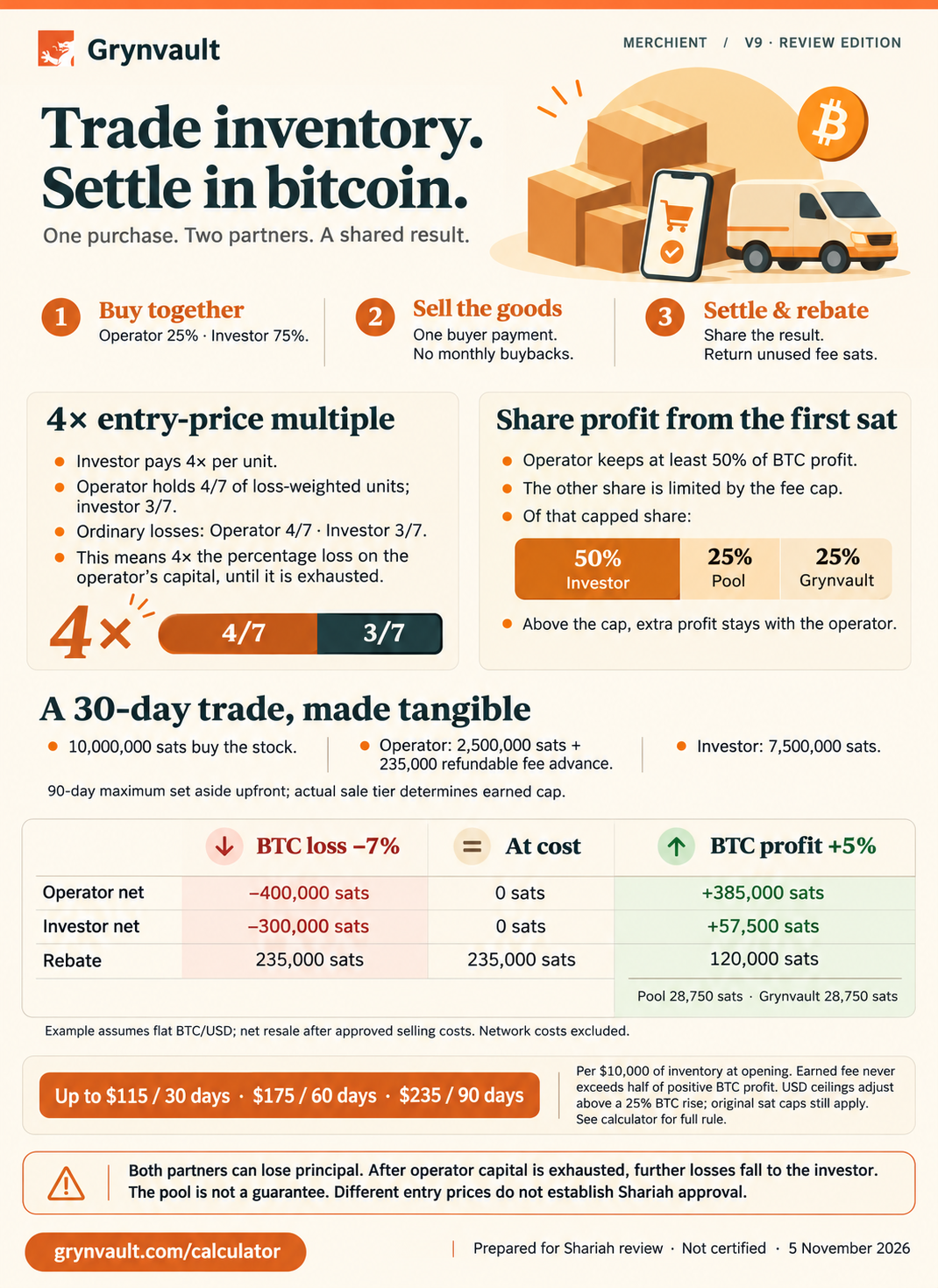
See the one-page infographic
Grynvault · V9 Shariah review brief
Prepared 5 November 2026 · Proposed commercial design · No certification claimed
What we are asking reviewers to assess
Can the proposed BTC inventory partnership be documented and operated permissibly, and which provisions need to change? The commercial intention is real co-investment in identified goods, measurable business activity, shared ordinary downside, and profit contingent on a completed trade. This brief describes the actual calculation, including the asymmetric provisions; it does not assume that these intentions validate the contract.
Run the calculator · Download the infographic · Read the exact model source · Download the settlement fixtures
1. Parties and the trade
One investor and one operator sign a master governing their relationship. Every unit or defined lot has a separate accepted schedule: goods, supplier, title and possession, capital, costs, sale route, term, BTC inputs, dispute process and exit authority. The schedule is not a freely transferable token. No automatic credit line, public investment solicitation or automatic reinvestment is proposed for the pilot.
The operator contributes 25% of the BTC acquisition cost; the investor contributes 75%. The price goes to a verified supplier. The operator takes the agreed custody and sales responsibilities. An outside buyer pays through the designated closing route. Net confirmed BTC proceeds are allocated once; no monthly buybacks are required. Fees, capital and proceeds are not reused between deals. Who has legal title, constructive possession and agency authority must be resolved for the launch jurisdiction before a live trade.
2. The 4× multiple: the question that needs a ruling
The proposed investor entry price per unit is four times the operator’s. With 75/25 cash contributions, the number of loss-weighted units is 3/7 investor and 4/7 operator. The calculation allocates ordinary BTC losses 3/7 and 4/7 respectively until the operator’s original capital is exhausted. Further losses fall to the investor. There is no contractual replenishment of an ordinary loss in this model.
This is a proposed loss-allocation formula, not a conclusion that unequal entry prices permit it. The model returns each party’s original BTC capital at a break-even exit; it does not distribute all proceeds at a fixed 3/7–4/7 ownership ratio. Reviewers should assess whether the proposed units and capital accounts represent valid ownership or an impermissible preferential capital arrangement. The software does not establish the legal or Shariah substance.
For context, the State Bank of Pakistan’s Islamic-banking guidance describes Musharakah losses in proportion to contributed capital, with profit allocated by an agreed ratio of actual profit, and rejects a fixed sum or investment-linked rate as a partner’s profit entitlement. Our inference is that the departure from 75/25 loss sharing and the capped profit arrangement require express review rather than a compliance claim. This reference is not a ruling on this transaction. SBP guidance
3. Profit sharing and the fee cap
Positive net BTC trade profit is shared from the first sat. At least half stays with the operator. The other half is subject to a cap. Of the capped gross share, the default allocation is 50% investor, 25% loss pool and 25% Grynvault. Thus, below the cap, the effective share of total positive profit is 50% operator, 25% investor, 12.5% pool and 12.5% platform. Profit beyond the capped amount stays with the operator.
There is no separate 25% investor-return cap carried over from earlier versions. The V9 caps are 1.15%, 1.75% and 2.35% of the whole opening acquisition cost for sales within 30, 60 and 90 days. These are maximum gross profit-share amounts, not guaranteed interest or annual rates. Changing the actual sale outcome can reduce the earned share to zero.
Review questions: Is this profit allocation, including its capital-and-time-based ceiling, permissible as written? Would profit ratios, a voluntary waiver of surplus or a different service-fee arrangement be required instead? What is the legal and Shariah basis for the platform’s share and pool deduction, and who authorizes each?
4. Full fee advance, actual sale tier and rebate
The operator separately deposits the full opening 90-day fee maximum in BTC. It is restricted refundable property, not partnership acquisition capital, revenue, a conduct bond or a first-loss guarantee. It is not invested or used to pay suppliers. On closing, only the earned capped share is distributed; unused sats are returned to the operator. On a BTC loss or break-even trade, the whole advance is refunded. A dollar gain in the deposit’s translated value is not trade profit.
This review edition layers the agreed pilot workflow onto unchanged V9 arithmetic: full 90-day advance, actual verified sale tier, and no incremental fee after day 90. The earlier calculator selected a quoted tier independently from elapsed days and advanced only that tier’s maximum. The public calculator identifies this change.
Tier time is the independently evidenced binding sale commitment under the signed closing policy, not a dealer’s editable date. An unsigned offer, canceled sale or sale without eventual cleared proceeds does not earn a payout. Human reconciliation delay alone cannot raise the tier. Reviewers should assess characterization of the deposit, custody/escrow, refund timing and treatment on insolvency.
5. Bitcoin denomination and the dollar ceiling
BTC/sats govern costs, trade profit and distributions. A fiat selling price is converted into actual net BTC received. USD/CAD display values are a convenience; this public calculator uses explicitly assumed BTC/USD rates, not a live execution quote. A USD-profit trade can lose BTC.
Let C be opening cost in sats, S actual net sale sats, b the applicable 0.0115/0.0175/0.0235 tier, and r closing BTC/USD divided by opening BTC/USD:
- Opening tier sat cap B = C × b, rounded to sats.
- Collectible cap K = min(B, floor(B × [1 + max(0, r − 1.25)] / r)).
- Earned gross share G = min(K, floor(max(0, S − C) / 2)).
- Refund = full opening 90-day advance − G.
The dollar cap does not rise until BTC increases more than 25%; then only the excess rise increases it. Original sat caps always apply. At 2× BTC, a US$115 opening ceiling becomes at most US$201.25. This does not protect principal from BTC appreciation.
Review questions: Is BTC an acceptable accounting and settlement asset for these contracts? What exchange/possession requirements apply to fiat conversion? Are the cap’s FX adjustment and fixed-source timing sufficiently certain and permissible? Would a simpler BTC-only ceiling be preferable?
6. Worked closing statements
Illustration: 10,000,000 sats acquisition; operator capital 2,500,000; investor capital 7,500,000; operator refundable advance 235,000. Sale on day 30. BTC/USD flat at US$100,000. Net sale receipts exclude approved selling costs; network costs are excluded here.
| Sats | −7% BTC resale | At cost | +5% BTC resale |
|---|---|---|---|
| Buyer net proceeds | 9,300,000 | 10,000,000 | 10,500,000 |
| Operator from buyer | 2,100,000 | 2,500,000 | 3,000,000 |
| Operator rebate from advance | 235,000 | 235,000 | 120,000 |
| Operator total receipts | 2,335,000 | 2,735,000 | 3,120,000 |
| Operator net against all 2,735,000 paid | −400,000 | 0 | +385,000 |
| Investor total receipts | 7,200,000 | 7,500,000 | 7,557,500 |
| Investor net against 7,500,000 paid | −300,000 | 0 | +57,500 |
| Pool | 0 | 0 | 28,750 |
| Grynvault | 0 | 0 | 28,750 |
At −7%, the operator loses 16% of their capital and investor 4%: four times the proportional loss. This relationship ends when the operator’s capital is exhausted. At a 100% ordinary write-off both lose all acquisition capital; the unused fee advance remains separately refundable if custody remains intact.
If BTC doubles while a US$10,000 item sells for US$10,500, net sale is only 5,250,000 sats: operator capital is exhausted and investor receives those 5,250,000 sats; the fee advance is returned. No principal guarantee is implied.
7. Unsold stock, default and operator buyout
At day 90, pause new dealer purchases and obtain independent bids. Choose an outside sale, a funded operator match or one mutually agreed extension. At day 180 start the agreed disposition process. No buyer means inventory remains open; a deadline does not invent proceeds or require repayment at par.
An operator can match the best bona fide net offer, paying the investor’s calculated settlement from outside funds and taking the asset. Example: 10,000,000-sat cost, independent bid of 8,600,000 net sats. Under the proposed loss rule, the investor receives 6,900,000 and operator’s residual is 1,700,000. The operator can pay 6,900,000 to acquire the remaining interest; the separate unused advance is refunded. No second credit for the operator residual.
Ordinary market loss, proven misconduct and sale proceeds diverted by the operator are separate cases. Evidence, duties, arbitration and permitted recovery require contract review. A blanket principal guarantee is not proposed. Independent bids reduce price manipulation; they cannot eliminate collusion or create liquidity.
8. Custody and the loss pool
Proposed pilot custody is separately accounted deal funds with external multisig approval: operator, investor and an independent dispute/recovery signer. The app observes and prepares transactions. Any two signers can technically spend; governance is not cryptographic proof against collusion. A BTC wallet cannot prove physical possession or title.
Pool contributions come only from earned shares. No reimbursement is assumed in investor returns; no insurance or guaranteed benefit is promised. Governance, beneficiary eligibility, conflicts, payment authority, permitted investments if any and dissolution are undecided. Review the pool separately before enabling distributions.
9. Requested review output
For each issue, please identify whether the proposal is acceptable, requires changes, or cannot be approved on the supplied evidence; specify the contract language and operational proof needed.
- Partnership classification; genuine title/possession, agency and permitted goods.
- Cash capital versus unequal unit prices, ordinary loss allocation and principal accounts.
- Contingent profit ratios, cap, time tiers and any necessary waiver structure.
- Characterization and segregation of the refundable fee advance; platform compensation.
- Pool contributions, governance and any promised protection.
- BTC denomination, FX fixing, currency conversion and settlement finality.
- Independent-price buyouts, mandatory disposition, misconduct remedies and arbitration.
- Master agreement plus unit schedules, amendments, expenses, returns and insolvency.
- Required documentary evidence and conditions before live approval.
Legacy materials, sidecar reserves, charity bonds, consumer BNPL and prior 25% profit-priority examples are not included in this proposal. The public website is discussion material, not a live offer or a statement of religious approval.